White Hat SEO: What It Actually Means and Where the Limits Are

A practical look at white hat SEO. The legitimate version of the strategy, the honest limits of "white hat only" promises, why the label matters less than how the work is done, and the questions to ask any provider who puts "white hat" on their homepage.
White hat SEO is the version of search optimization that follows Google’s published guidelines. Cleanly, fully, no shortcuts. It’s also the label nearly every SEO provider puts on their homepage, and most of them are not telling you the whole story.
That gap, between the label and the work, is what this guide is about. What white hat actually means, what it can realistically do, where it runs out of road, and the question I think matters more than the label: how is the work actually being done, and can you see it?
Where a screenshot makes the point faster than a paragraph, I’ve used examples from the way we run campaigns for partner agencies. One of them uses a stand-in client name so nothing real is exposed.
What white hat means
White hat SEO is rule-following. Optimization that sticks to the published guidelines from Google and the other major search engines. In practice it breaks into three buckets.
On-page optimization done correctly. Site architecture organized through proper theming and siloing. Natural keyword use in titles, metadata, and body copy. Technical hygiene: a clean robots.txt, canonical URLs, sensible schema markup, HTTPS with a valid certificate, page speed and Core Web Vitals in good shape, and a site that works on a phone.
Content that earns its rankings. Original, substantive pages. Topical authority built through depth and breadth of coverage. Content that answers what the searcher actually asked, refreshed as it goes stale.
Link building that earns its links. Resources good enough that people share and cite them. Editorial coverage from journalists and publications. Podcast interviews and thought leadership that produce mentions naturally. Real relationships that turn into links over time.
The principle behind all three: do the work that creates real value, and visibility follows. It’s slower than the alternatives. It’s also more durable when it works, because there’s nothing to unwind later.
Where white hat hits limits
The marketing version of white hat SEO says it can hit any ranking goal in any market with enough patience. The honest version knows where the edges are.
Competitive verticals push the math. In personal injury law, plastic surgery, financial services, and any other category where the competition has deep pockets and aggressive tactics, pure white hat at small or medium scale often can’t catch up. The well-funded competitor with a gray-hat link program outpaces the smaller one running clean.
Time horizons can be punishing. White hat campaigns measured in 12 to 24 month timelines are normal. A business without that runway either drifts toward faster tactics or moves the budget to paid ads.
Pure earned-media link building is genuinely hard. Producing original research, distinctive content, or thought leadership that earns editorial coverage at scale takes real investment in content, real relationships with journalists, and real expertise to communicate. Most agencies don’t have the capability in-house and most clients won’t fund it externally.
The line between white hat and gray hat is fuzzier than the marketing suggests. Reaching out to a partner about their existing resources page (white hat) and offering to write them a guest post (gray hat) sit uncomfortably close together. Most working SEOs spend their day somewhere along that spectrum.
What “white hat” usually means in practice
When a provider markets themselves as white hat, the honest translation is usually one of three things.
Genuinely white hat at small scale. Local businesses or small sites where the competition isn’t intense and earned tactics actually get you there.
Mostly white hat with a thin layer of gray that doesn’t get advertised. The most common version by far. Guest post outreach, link exchanges with partners, slightly aggressive optimization of internal pages. Defended publicly as white hat because nothing is overtly malicious.
Marketing positioning that doesn’t match operational reality. White hat as a sales claim, with whatever produces results executed quietly. Common in mid-size agencies.
For the broader picture, our link building guide walks the white, gray, and black hat spectrum tactic by tactic.
The label is the wrong question
Ask me whether we’re white hat and I’ll ask you what you mean by it.
I’m not dodging. I’ve been on the wrong end of a network de-indexing, and I’ve watched clean-as-a-whistle sites get filtered for thin content nobody thought was a risk. The hat a vendor claims told me nothing in either case. What told me everything was how the work was done.
Risk in SEO comes from three places. Whether anyone checks a change against the live page before it ships. Whether a human signs off on anything that touches the site. And whether the links point at the site from places you’d be comfortable showing the client. A provider can be “white hat” and fail all three. A provider can run gray-hat tactics and pass all three, and be the safer of the two.
So here is what “how the work is done” looks like when you can actually see it.
Standing rules that nothing overrides
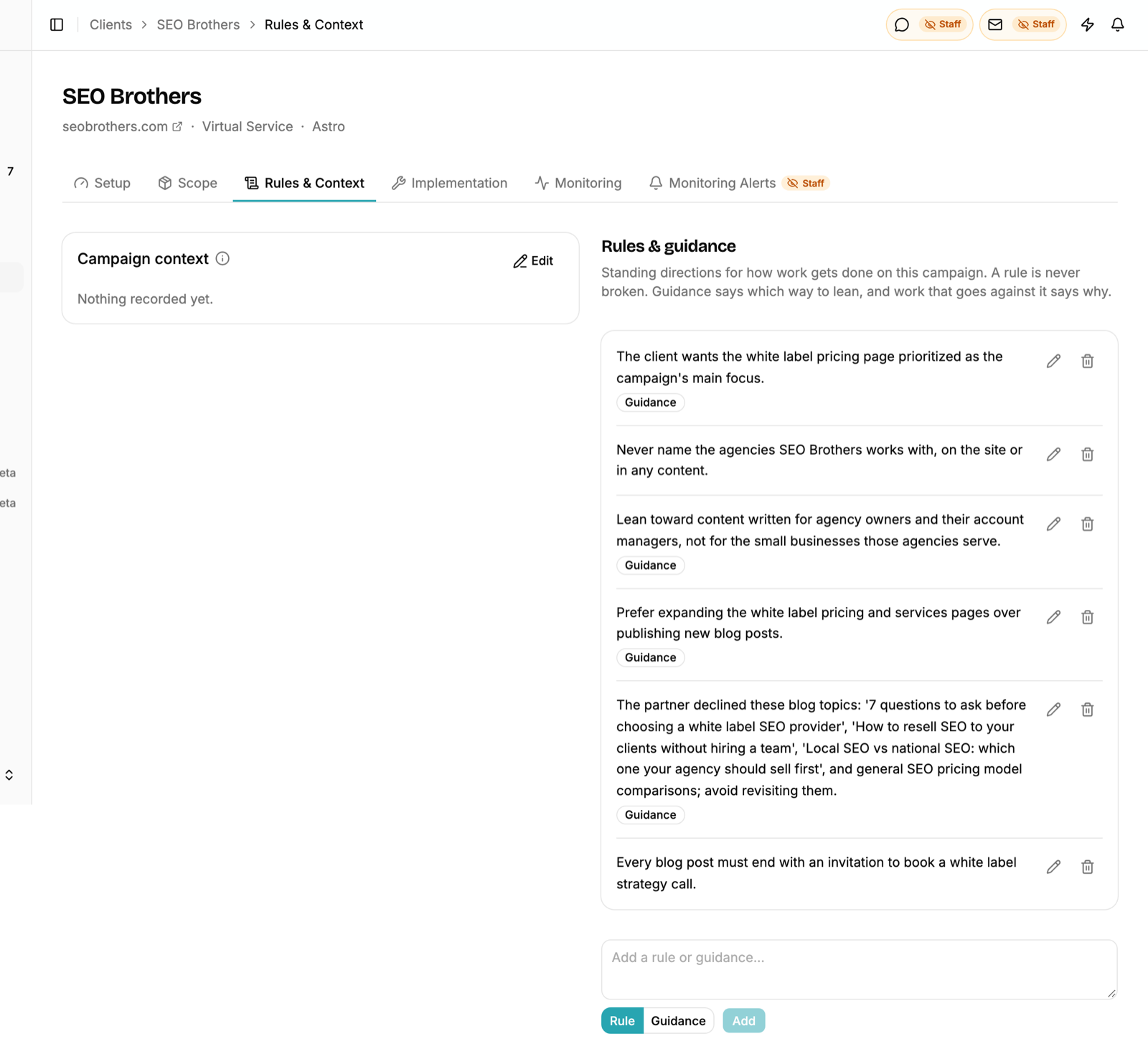
Every campaign should have a written set of rules the work has to follow. Never name our partners. Never mention a competitor by name. Never touch the homepage without a call first. Then a separate set of guidance: the way to lean when it’s a judgement call.
The distinction matters. A rule is never broken, no matter what a tool or a strategy says would rank better. Guidance can be overridden, but only in a task that names the guidance and says why. If your provider can’t show you where those are written down, they don’t exist.
A human approves what touches the site
Plans, page edits, new drafts, and anything else that changes the client’s site should wait on a decision. Feedback goes back to whoever is doing the work word for word. A declined item stays declined; it doesn’t quietly come back next month under a new title.
This is the single biggest control you have over risk, and it’s the one most agencies give away when they hand a campaign to a vendor. Before you resell anyone’s SEO, ask to see the queue.

Links you could show the client
Here’s where most “white hat” claims fall apart, so look closely.
A link plan you can trust names the target page and the anchor text for every placement, months ahead. The anchors mirror what already ranks for the keyword, which in most markets means mostly branded and natural phrasing with a light touch of keyword anchors, rather than the exact-match wall that gets sites filtered. The same anchor doesn’t get repeated. A page that isn’t live doesn’t get a link. Every placement is its own article on its own site, so the client earns a new referring domain each time, and the published article is recorded where anyone can click through and read it.
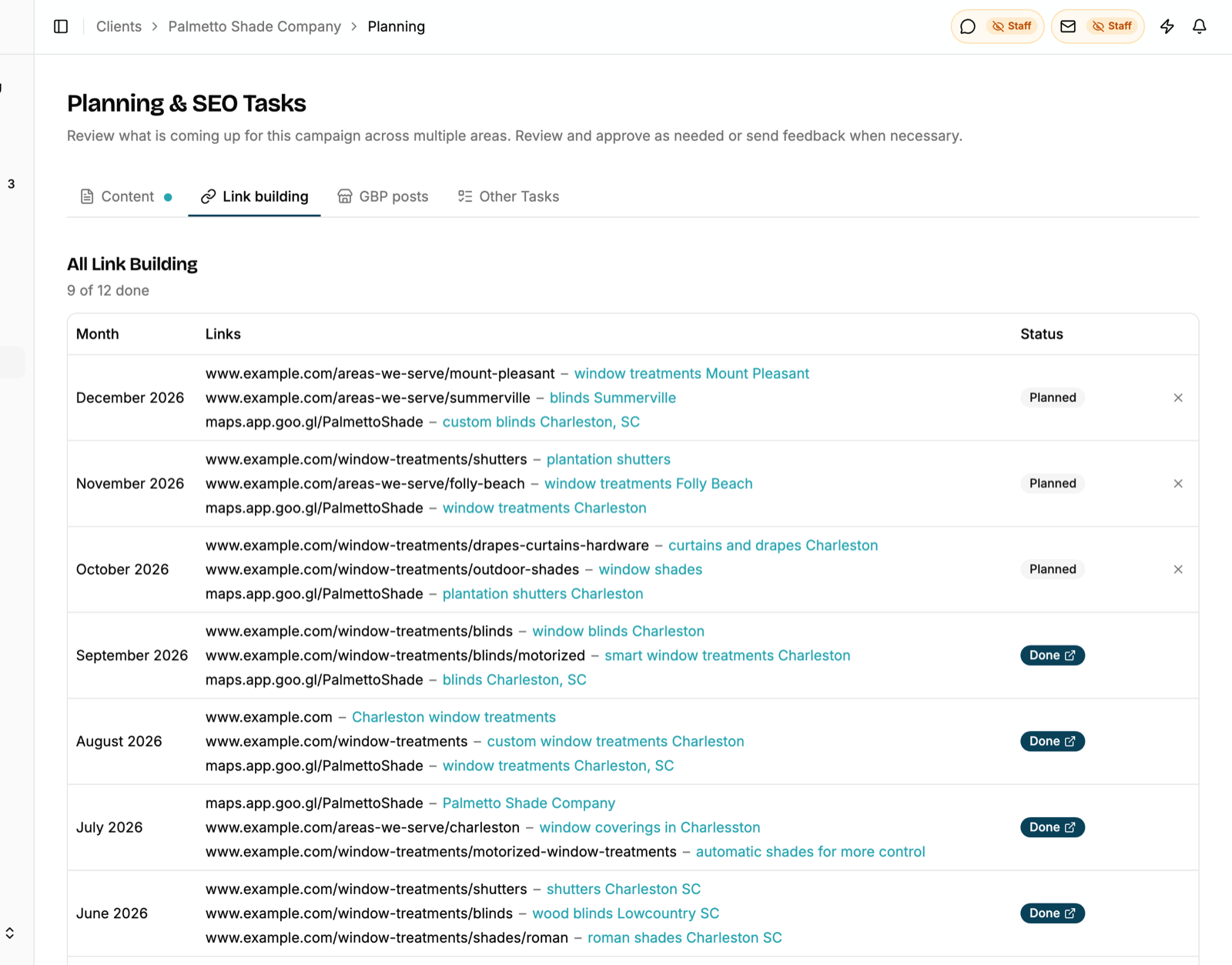
We publish those articles on owned media properties we operate, which we call the Publishing House. I’ve written elsewhere about private blog networks as an industry practice, and how the ones that last are run with discipline. The test I’d apply to any provider is the same: can you see the article, the site it’s on, and the anchor, and would you be fine with the client seeing them too?
White hat for local businesses
Most of the businesses our partner agencies bring us are local: a dental practice, an HVAC company, a three-location blinds franchise. For them, the white hat conversation is easier than the national one, and I think most providers make it harder than it needs to be.
Nearly everything that moves a local business is white hat by definition. A complete Google Business Profile with real photos and real posts. Consistent citations. Reviews from actual customers, asked for properly. Service pages that describe what the business does and where, written for a person and not a keyword density target. Our local SEO guide lays out the ten steps, and none of them cross a line.
The gray zone for a local business is links, and even there the white hat options are underused. The chamber of commerce. The suppliers and the trade association. The local charity run the owner sponsors every year and has never once asked for a link from. The neighbourhood news site that covers new businesses. These are slow to collect and nobody will sell you twenty of them a month, which is exactly why they hold their value.
Where a local business gets into trouble is almost never the tactic. It’s a provider who took a $500 budget, needed to show movement, and bought the cheapest links they could find. Which brings us back to the question of how the work is done.
Black hat for context
The other end of the spectrum, listed for definitional clarity rather than as a menu.
Black hat SEO uses tactics that explicitly violate the guidelines and would earn a manual penalty if detected: keyword stuffing, hidden text and cloaking, doorway pages built purely for keyword targeting, automated content at scale with no quality bar, aggressive paid link buying with no editorial filter, comment spam at industrial scale, hacking sites to inject links, scraping competitors’ content.
These tactics work, sometimes very well, until they don’t. The failure mode is usually a hard manual action that takes the site out of the index, often permanently. Operators who use them tend to work in expendable verticals where losing the site is part of the business model.
For a legitimate business, black hat is irrelevant. The risk-reward math doesn’t work.
The white hat investment reality
Real white hat SEO costs more than most clients expect. The pieces:
Content production. Substantive, expert-driven content costs money. Either you hire experienced writers in the industry, or you use the team’s own expertise (which has an opportunity cost), or you produce mediocre content that won’t rank.
Earned media outreach. Pitching journalists, building relationships, producing work worth covering. This is PR, and PR is expensive.
Patience. White hat needs budget commitment across multiple quarters, often years, because it runs on slower timelines than any other channel. Cash-flow-sensitive businesses often can’t make that commitment.
The disconnect I see most: a small business expects national results on $500 to $1,000 a month. The math doesn’t work at that level for any approach, and white hat is the most expensive one. The provider either takes the budget and quietly uses cheaper tactics, or passes on the engagement. The first option is how “white hat” ends up meaning nothing.
When white hat is the right choice
A few situations where strict white hat genuinely is the best call:
Brands with reputation exposure. Public companies, regulated industries, any brand that would suffer from a “company X caught using black hat SEO” news cycle. The upside of any non-white-hat tactic isn’t worth it.
YMYL categories with high scrutiny. Medical, legal, financial. Google watches these closely, and the trust signal of clearly compliant work matters.
Long-horizon campaigns with patient capital. Content-heavy publications, ongoing brand investments, projects measured in years.
Recovery from prior penalties. A site that’s already been manually penalized can’t afford anything that might trigger another action. Our disavow guide covers the rare cases where cleanup is actually the right move.
Questions to ask a provider who says “white hat”
If you take one thing from this guide, take this list. The answers tell you more than the label ever will.
- Can I see every change before it goes live, and can I say no? If the answer is a monthly report after the fact, you have no control over risk.
- What are the standing rules for my brand, and where are they written down? Vague reassurance is not a rule.
- Where do the links come from, and can I read the published articles? If they won’t show you, assume the worst.
- What happens when a tool flags something the live page doesn’t show? The right answer is that someone opens the page and decides. The wrong answer is that the tool’s list becomes the to-do list.
- What in your process is gray hat, and how do you manage the risk? A provider who says “nothing” is either tiny or not being straight with you.
Common questions about white hat SEO
Is guest posting white hat?
Strictly, no. Google’s position is that links should be earned, and a guest post written to get a link is built, not earned. In practice, guest posting done with real articles on real sites, with natural anchors, is the safest gray-hat tactic there is and most of the industry runs on it. Guest posting done with spun articles and exact-match anchors on sites that exist only to sell links is a different thing entirely.
Can a white hat campaign be penalized?
Yes. Algorithmic filters for thin or unhelpful content don’t care what tactics you used to build the pages. A “white hat” site full of thin location pages can lose rankings just as fast as a spammy one. Compliance with link guidelines is one part of risk, not the whole thing.
How long does white hat SEO take to work?
Twelve to twenty-four months for competitive terms is a fair planning horizon. Long-tail and local terms move faster, often within three to six months, because the competition for them is thinner.
Is white hat SEO more expensive?
Per result, usually yes. The content and outreach it depends on are the expensive parts of SEO, and you’re choosing to do more of them. The trade is durability: nothing to undo later.
What’s the difference between white hat and gray hat?
White hat follows the published guidelines completely. Gray hat violates them without being malicious: guest posts for links, paid placements, link exchanges. Black hat is deliberately deceptive or damaging. The risk in gray hat is set by how carefully the work is done, which is why the label alone tells you so little.
How we approach white hat SEO at SEO Brothers
Our default is layered. The foundation is white hat: on-page and technical work, content quality, earned links where we can get them. On top of that we add gray-hat tactics where the client’s risk tolerance and competitive situation justify them, with full transparency about what’s being done.
The controls are the same on every campaign. Written rules that nothing overrides. A human at the agency approving anything that touches the site. Links planned page by page and anchor by anchor, published on media properties we own, with the article on record.
We don’t market ourselves as white hat only. The claim isn’t accurate for the work most clients need, and I’d rather have the honest conversation about risk and trade-offs than sell a label.
If you’re trying to figure out which approach makes sense for your situation, get a free audit and we’ll walk through the trade-offs against your actual market.
Get our guides in your inbox
Pick what you want to hear about. No spam, unsubscribe anytime.
Check your inbox to confirm your subscription.