Multimedia SEO: Why Your Content Should Live in Five Formats

SEO stopped being a text-only sport a few years ago, and 2021 is the year that became impossible to ignore. The interesting question is how to ship one piece of source content across five formats without quintupling the workload.
For most of Google’s history, SEO meant publishing the best text page and earning links to it. Text was the format. Everything else was an accessory.
That hasn’t been true for a while. In 2021 it stopped being even partially true.
Google’s results page now reserves real estate for video carousels, image packs, and podcast results, news cards, knowledge panels, and social box-outs. A pure-text page competes for a shrinking percentage of pixels on the screen. The interesting question for SEO operators is how to produce one piece of source content and ship it across five formats without quintupling the workload.
One piece of content, five SERP surfaces
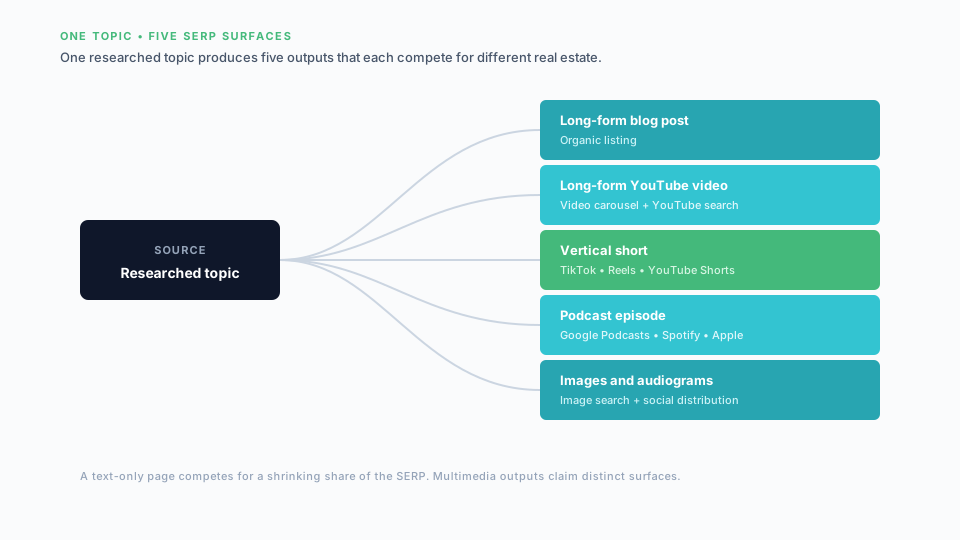
The right unit of work is a topic.
A single researched topic can become a long-form blog post, a long-form YouTube video, a vertical cut for TikTok and Reels and Shorts, a podcast episode, and a set of images and audiogram clips. Each one occupies different SERP real estate. Each one reaches a slightly different audience. The blog post wins the organic listing. The long-form video wins the video carousel and lives in YouTube search. The vertical short wins discovery on platforms where the audience already is. The podcast wins the podcast result. The images win image search and share well everywhere.
The marginal cost of producing a vertical cut from a horizontal video, or an audiogram from a podcast clip, has dropped to nearly nothing in the last few years, though each format still takes some additional work. Tools below.
What changed
Short-form video crossed an inflection point in 2021.
YouTube Shorts launched globally on July 12, after almost a year of beta-by-country rollout. Instagram Reels passed its first anniversary in August. TikTok was approaching a billion monthly users. Each of those platforms has a discovery algorithm that is fundamentally more generous to new accounts than Google’s algorithm has been in years. A vertical short with no audience can hit a million views on day one. A blog post with no audience cannot.
Meanwhile Google has been quietly making its SERPs more multimedia. Video carousels appear for queries that used to be text-only. Podcast results have been promoted further up the page since the indexing rollout in 2019. The June 2021 Page Experience update made multimedia performance, including Core Web Vitals, a ranking signal in itself.
The strategic implication is straightforward. The marginal SEO value of the seventh paragraph on your blog post is now roughly zero. The marginal SEO value of a vertical short cut from your supporting video, ranking on YouTube Shorts and surfacing in the YouTube carousel on Google, is not zero.
The demand behind multimedia SEO is measurable
If you want to know whether this shift is real, look at what people search for. Two patterns stand out: operators are actively hunting for the tactics, and the commercial service terms around multimedia SEO are close to uncontested.
Volumes below are US monthly from Ahrefs, July 2026. Difficulty is Ahrefs KD on a 0-100 scale; single digits are effectively open.
| Query | Monthly searches | Difficulty |
|---|---|---|
| youtube shorts | 270,000 | 64 |
| video marketing | 5,300 | 61 |
| youtube seo | 3,300 | 36 |
| youtube algorithm | 2,900 | 39 |
| image seo | 1,900 | 65 |
| video seo | 1,800 | 39 |
| video schema | 1,700 | 39 |
| tiktok seo | 1,600 | 30 |
| video content marketing | 1,200 | 28 |
| podcast seo | 1,100 | 7 |
| seo for images | 1,000 | 37 |
| podcast marketing | 1,000 | 19 |
| short form video | 900 | 39 |
| vertical video | 900 | 11 |
| content repurposing | 600 | 47 |
The interesting cells are the low-difficulty ones. “podcast seo” at KD 7, “vertical video” at KD 11, “podcast marketing” at KD 19: these are topics with real audiences and almost no serious competition for the informational query. “video schema” pulling 1,700 searches a month tells you people know the markup exists and want to implement it, which most sites still do badly or not at all.
The commercial side is even more lopsided. If you sell SEO, “video seo services” and its variants are the rare high-intent, buyer-stage terms sitting at low single-digit difficulty.
| Query | Monthly searches | Difficulty |
|---|---|---|
| video seo services | 1,000 | 2 |
| video seo company | 900 | 3 |
| video marketing seo | 900 | 10 |
| seo video marketing | 800 | 7 |
| video seo service | 600 | 1 |
| video seo expert | 500 | 1 |
| video seo tools | 500 | 12 |
| video seo agency | 400 | 0 |
These are buyers, and KD 0 to 3 means almost nobody has built a real page for them. Compare that to the head “seo services” market, where you fight every agency on the planet. The multimedia specialty is wide open on the commercial side, which is why we treat it as a service line.
The tools
Three to five years ago, repurposing across formats was the job of an in-house video editor, a podcast producer, and a designer. In 2021 you can do most of it with a small stack of software tools.
Kamua is the most ruthless example of what AI can take off the editing table. Their AutoCrop tool takes a horizontal video and produces a vertical cut, using computer vision to track the subject so the framing stays correct as the speaker moves. AutoCaption produces subtitles in over sixty languages. AutoCut splits a recording into component shots. The whole pipeline runs in the browser on GPU infrastructure, which means a long video that would take a desktop editor twenty minutes to render is done in two.
Descript is the closest thing the audio and video editing world has to a single-tool studio. It transcribes a recording, lets you edit the audio or video by editing the transcript text, and applies the cuts to the underlying media. For podcast and talking-head video work it has effectively replaced the linear timeline editor for most operators we run into.
Veed.io sits in the same space as Kamua and Descript but skews toward simple browser-based editing with subtitles, brand kits, and templates. Lower ceiling, lower learning curve. Good for teams that need to ship a lot of short cuts quickly without training people on a heavier tool.
Riverside.fm is the recording end of the podcast and interview pipeline. It records each participant’s audio and video locally at full quality, then uploads the files separately, so a remote interview ends up with broadcast-grade source material rather than the compressed mess most video calls produce. That source material is what makes downstream repurposing actually viable. Garbage in, garbage out is a real constraint on this whole workflow.
Otter.ai is the transcription utility under everything else. It turns recorded audio into searchable, editable text, which is what makes the blog-post-from-the-podcast and captions-on-the-short workflows possible. It also handles real-time meeting transcription if that’s relevant to your operation.
Headliner is the audiogram tool. Take a clip of audio, generate a video with a waveform animation and captions overlaid on a still image, post to social. It is unglamorous but it solves a specific problem, giving an audio asset somewhere visual to live, that no general-purpose video tool handles cleanly.
Making any of this actually indexable
Producing the multimedia is half the job. Making it findable is the other half.
Danielle Marshak’s March 2021 Lightning Talk on the Google Search Central channel is the canonical reference for the rest of this section. Five-minute version of what follows.
Add VideoObject schema to your blog post and to the YouTube video’s host page. Video carousels in SERPs draw from this markup. If Google cannot parse what your video is about, the long-form video will not compete for the carousel slot.
Publish full transcripts of every podcast episode and long-form video on your site. Transcripts make audio and video content crawlable, give you long-tail keyword coverage, and double as the source for blog post versions of the same material.
Use timestamps in YouTube descriptions for any video over five minutes. Google now shows “key moments” cards in YouTube results that come directly from timestamped chapters. Two minutes of extra work, real SERP real estate gain.
Alt text and Open Graph metadata on every image and audiogram. Image search is small compared to web search, but it compounds. A thousand alt-tagged images across a site accumulate into a meaningful traffic source.
The structured data that actually gets multimedia indexed
The checklist above is the short version. The specific, current requirements live in Google’s own documentation, and they have tightened since 2021.
For video, the workhorse is VideoObject structured data. Google requires three properties to consider a video for its features: name, thumbnailUrl, and uploadDate. It strongly recommends contentUrl or embedUrl, description, and duration on top of that. Skip the required three and the video does not qualify, no matter how good it is.
Two constraints trip people up. First, the watch page hosting the video has to be indexed and, in Google’s words, “performing well in Search before its video can be considered for indexing.” A bare YouTube upload with no supporting page on your own site leaves that value on the table. Second, the video cannot be hidden behind other elements on the page unless you use paywall markup. Google spells both out in its video best practices, which also notes there are three separate ways to hand Google your video metadata: structured data, video sitemaps, and the Open Graph protocol. Pick one and do it properly rather than half-implementing all three.
Key Moments is the feature worth the extra effort. It gives your video the chapter-style navigation links that show up under video results. You enable it with Clip markup (you specify exact start and end times and labels) or SeekToAction markup (you tell Google how timestamps appear in your URLs), or, for YouTube-hosted video, simply by adding timestamps to the description. That last option is two minutes of work for real SERP real estate, which is why it made the original checklist. Against a backdrop of most sites shipping zero structured data, doing this properly is the whole opportunity.
What most operators are still missing
The SEO industry is still treating multimedia as an optional enhancement to text-first content. Most agencies offer “blog content” as a line item and treat video as a separate, more expensive service. Most clients have a content calendar that maps cleanly onto blog posts and barely accommodates anything else.
The shape that wins the next three years of search is a content workflow where one researched topic produces five outputs, and the SEO operator is responsible for all five. The tools listed above make this economically feasible in a way it was not even two years ago. The strategic shift is the part that is still catching up.
How AI answers changed the multimedia calculation
The version of this guide written in 2021 could stop at “make it, mark it up, distribute it.” By 2026 there is a layer sitting on top of all of that. AI Overviews and the various answer engines now resolve a large share of informational queries before the searcher clicks anything.
This is a layer on top of an organic foundation. The content an AI answer pulls from is the same well-structured, well-linked content that ranks organically. Multimedia strengthens that foundation in two specific ways.
First, transcripts. A podcast or long-form video with a full, clean transcript on the page is text a language model can read, quote, and cite. An audio or video asset with no text attached is invisible to the systems now deciding which sources to surface. The transcript you publish for crawlability doubles as your ticket into AI answers.
Second, demonstration. For how-to and “show me” queries, AI results increasingly pull in video as a supporting element, because a clip shows a physical process better than any paragraph describes it. Owning the clearest demonstration of a task is a durable position.
The demand around this vocabulary is new and climbing. “generative engine optimization” pulls 7,800 searches a month, “ai overviews” 5,900, “answer engine optimization” 4,700, and “geo seo” 2,700 (Ahrefs, US, July 2026), none of which meaningfully existed when this guide first published. The practical shift: put the direct answer near the top of the page in plain language, structure content for extraction with short definitions and scannable steps, and accept that the value of the raw click is falling while the value of being the cited source is rising. Multimedia is what makes you the source worth citing. For the deeper treatment, see our AI SEO guide.
Common questions about multimedia SEO
Does video actually help my rankings, or just my YouTube channel?
Both, through different doors. A video embedded on a page with VideoObject markup can earn a thumbnail in the results and feed the video carousel. The same video on YouTube competes in YouTube search, which is its own second-largest search engine. Those are two separate contests, and one well-produced video enters both.
Do I need to host the video on my own site, or is YouTube enough?
For most operators, YouTube for the video plus your own page with an embed, a transcript, and structured data. Google’s documentation is explicit that the watch page has to be indexed and performing before the video is considered for its features, so a standalone YouTube upload with no supporting page is doing half the job.
If I only publish blog posts today, what is the highest-leverage format to add first?
A vertical short cut from a talking-head video, or a podcast with a published transcript, depending on where your audience already spends time. Both hand you a second SERP surface and a discovery channel with a friendlier algorithm than organic search. The tools above have pushed the marginal cost of a short cut close to zero.
How many formats is realistic for a team of two or three?
Start with two beyond the blog post and run them consistently rather than launching five and abandoning four. One long-form video plus the short cuts pulled from it is the usual highest-return pair. Add the podcast and audiograms once the video workflow has become boring.
Is podcasting worth it for SEO specifically?
Its value is indirect: the transcript is long-tail text, the episodes feed the blog and the shorts, and “podcast seo” at KD 7 tells you nobody is competing for the discovery terms. A podcast will not rank the way a high-intent commercial page does. It earns its place as a content engine.
How we approach this at SEO Brothers
We are a technology-first SEO company offering white-label SEO to agencies and growth-focused operators. That means we pay close attention to where the SERP is going. Multimedia is still the most underweighted area we see in client content calendars, and the gap between operators who ship across formats and operators who publish text and hope has only widened since we first wrote this.
The way we run it white-label is one workflow: one researched topic, a blog post plus a long-form video, short cuts and audiograms pulled off the back of it, structured data on everything, and transcripts doing double duty as long-tail text and AI-extractable source material.
If you have a client whose content calendar stops at blog posts, run a free discovery and we will map the multimedia workflow that fits their audience, then deliver it under your brand.
Get our guides in your inbox
Pick what you want to hear about. No spam, unsubscribe anytime.
Check your inbox to confirm your subscription.