Specialist agents pick their own tasks, and staff can correct an agent that gets stuck

Each specialist agent now says which tasks it picks up, and when one gets stuck a strategist can answer it directly and it finishes the job. Hand-written tasks are read against the task standards before they are saved.
A Saturday on the agent system: how specialist agents pick up work, and what happens when one gets stuck.
For our partners
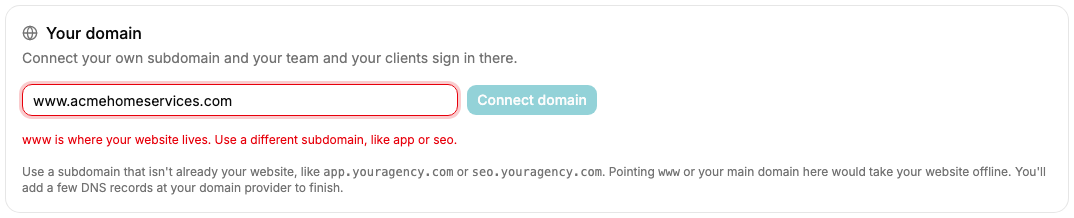
The client portal domain field refuses www and the bare domain and says why. Pointing either at the portal would take the client’s website offline, and nothing on the screen said so until a partner nearly did it.
On Asks & Approvals, answered questions read as one row each and withdrawn ones fold into a collapsed group instead of filling the page.

Behind the scenes
- Each specialist agent now says, on its own row, which tasks it picks up: what kind, which lane, what status, whether approved, when due. Seven specialists replaced three catch-all agents that treated every kind of task the same way.
- When an agent gets stuck, a staff member replies to the escalation as a correction, their word outranks every rule and note the agent holds, and the agent fixes its notebook and finishes the job.
- Tasks our team writes by hand are now read against the task standards before they are saved, the same two documents agents read every time they work.
1. Specialists pick their tasks
The task is assigned to the agent before it starts and it can work only that task, so nothing about which task is left to the agent and nothing about which agent is left to code. The situations they pick up are named and defined in one place, so a wrong definition is fixed once for every agent using it. One visible effect: approved content publishes on the specialist’s next scheduled pass rather than at the moment of approval. Each agent is also labelled for people as Process, Specialist or Feedback, with what starts it shown beside.
2. Correcting a stuck agent
A guest post writer withheld an article because it read a rule naming six on-site surfaces as covering a link on another site, and nobody could tell it otherwise: the alert carried only a reference number and the conversation could not be replied to. The escalation now links straight to the agent’s work. A writer that declines never blocks the placement; it waits on the escalation. Every rules block now opens with the reading rule: a rule covers the surfaces it names and nothing else.
3. Checking hand-written tasks
We tried four AI reviewers on twelve tasks we had already judged and kept the one that read all twelve right.
Get these updates by email
A short note when something changes on the platform, plus whatever else you pick.
Check your inbox to confirm your subscription.