White-Label SEO Audits: How We Run Them for Partner Agencies

White-label audits for agencies that want to sell SEO without an in-house SEO team. What you send, what comes back, the three audit types and what each is for, the difference between a tool that finds issues and an audit that decides what to do, and the questions to ask before you put your brand on someone else's audit. With examples.
White-label SEO audits are how digital agencies offer SEO without building an in-house SEO team. The audit goes out under the agency’s brand, the analysis is done by a partner, and the agency keeps the client relationship.
For agencies focused on web design, paid media, branding, or other adjacent services, the audit is usually the entry point to a broader white-label SEO partnership. It produces immediate value for the agency’s clients and surfaces the engagements the agency can then fulfil through its partner.
This guide covers what a white-label audit has to do to be useful, what you send and what comes back, the three audit types, the honest difference between audit software and an audit, what happens after the sale, and the questions to ask before you resell anyone’s audit. Where a screenshot makes the point faster than a paragraph, I’ve used examples from the audits we run for partner agencies, shown with a demo agency and a stand-in client so nothing real is exposed.
The factors that matter for white-label audits
Three things determine whether a white-label audit is useful to the agency and to the end client.
It has to be actionable. A 200-page PDF nobody reads is an artifact, not an audit. The deliverable has to identify specific issues, prioritize them by impact, and recommend specific actions that someone (the agency, the client, or the SEO partner) can implement.
It has to be branded as the agency’s. The end client should see a deliverable that looks like the agency produced it, from the logo to the domain it’s hosted on. A third-party template with a logo dropped on top signals the opposite of what the agency is trying to project.
It has to surface the right level of detail. A free audit for business development should be focused, presentation-friendly, and end with a clear next step. A paid audit or campaign-start audit warrants full depth. The same template doesn’t serve both.
What you send
The audit is only as good as the brief behind it. What we ask the agency for, for every audit type, is the same short list.
The website. The business name and, where the agency has one, the brand the audit goes out under. The Google Business Profile locations, so the local comparison has something to compare. Up to three competitors, ideally the ones the prospect loses business to rather than the biggest names in the category. Where the agency is in the sales cycle with the prospect, the budget range, and a few lines on the services, locations, and search terms the prospect cares about.
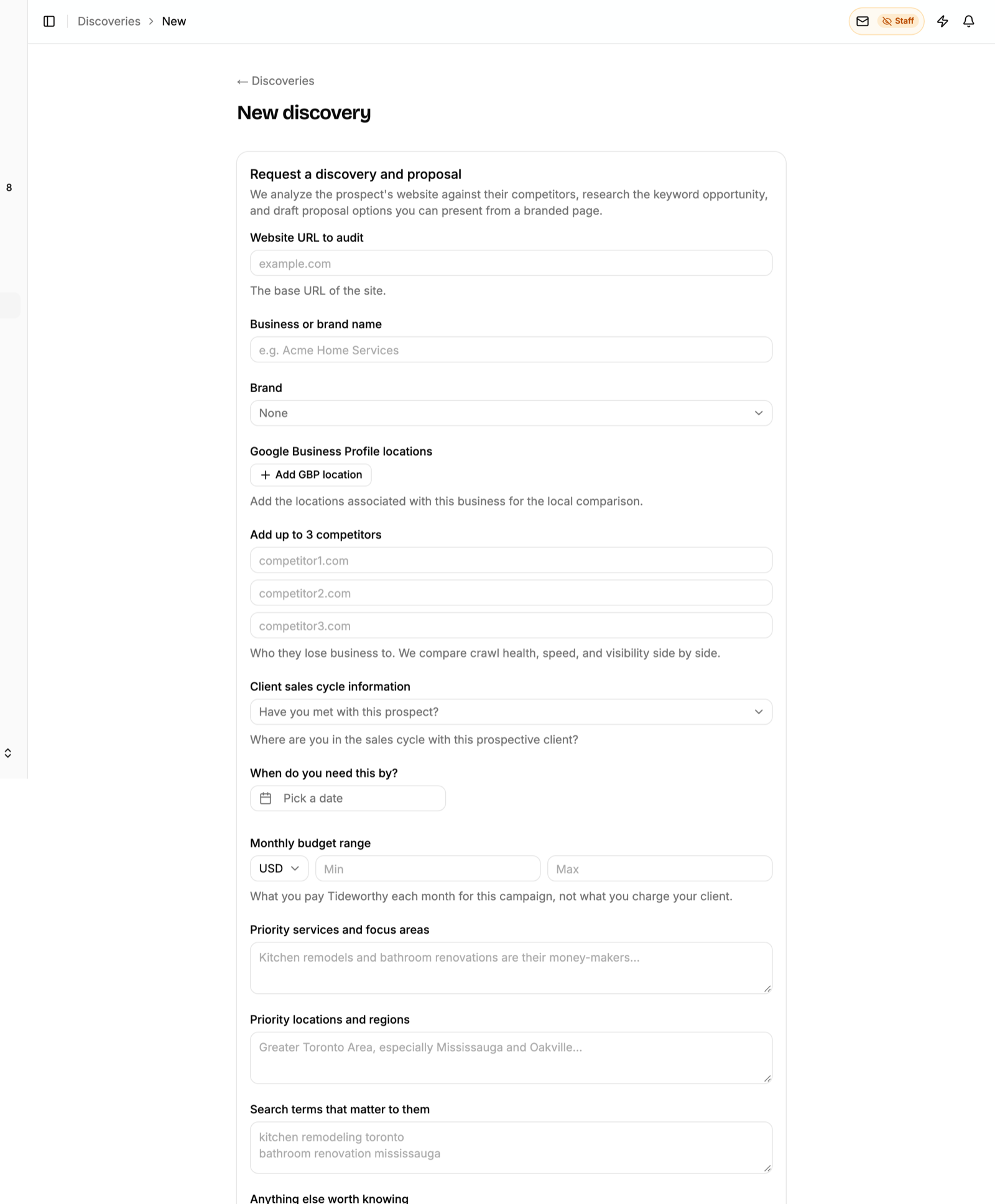
The competitor field is the one agencies skip and the one that matters most. An audit that says “your page speed is poor” is a tool output. An audit that says “your page speed is 21 out of 100 and the competitor holding the top spot is at 100” is a sales conversation.
Three types of white-label audits
We run three audit types for partner agencies, each serving a different stage of the client relationship.
Free audits for business development
The agency offers a free SEO audit to prospects as part of the sales process. The audit produces enough insight to demonstrate value and create urgency, without handing over the full implementation roadmap.
Typical scope: a scored review of the site against its named competitors, a keyword opportunity table with current positions, the local visibility picture where there’s a location, and proposal options. Delivered as a branded page the agency presents from, with a walkthrough where the deal warrants it.
Conversion goal: the prospect engages the agency for SEO or related services.
Turnaround: 2 to 3 business days. The data pull and first draft come back the same day; the rest is a person reading it against the market before it goes anywhere near a prospect.
Paid discovery audits
Sold as a standalone service. Deeper than the free audit, with fuller findings and a complete roadmap.
Typical scope: full technical audit, complete content audit, link profile analysis, competitive benchmarking, and a prioritized roadmap with effort and impact estimates. Delivered as a comprehensive document plus a presentation.
Conversion goal: the client implements with their own team, or engages the agency for implementation.
Pricing: typically a few thousand dollars, scaling with site size and complexity. Structure varies by partner agency.
Turnaround: 1 to 2 weeks.
Campaign start audits
Bundled into the kickoff of an ongoing engagement. This audit produces the baseline that campaign progress is measured against and the priority work for the first stretch.
Typical scope: the full audit plus the campaign plan: the initial keyword research and the keyword-to-page mapping, the content plan, the link plan, and the reporting structure. Each of those goes to the agency for approval before work starts.
Conversion goal: the campaign launches with clear scope and aligned expectations.
Included in the campaign cost rather than priced separately.
What’s in every audit
Regardless of type, every audit covers the same six dimensions, with depth scaled to the audit type. For the full methodology, see the SEO audit guide. What follows is what the agency and the client actually see.
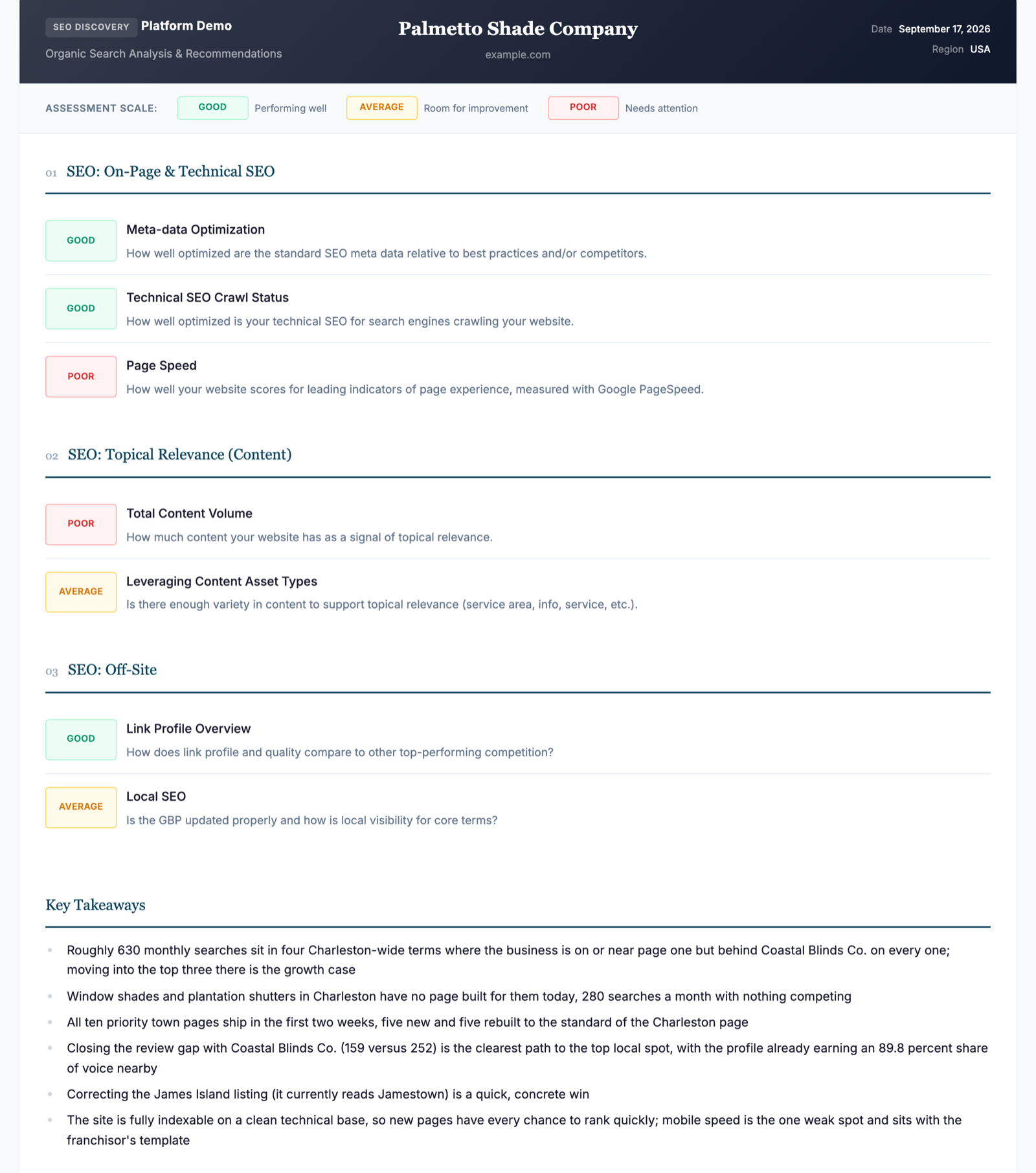
A scorecard. Eight fixed items across on-page and technical, content, and off-site, each scored good, average, or poor against what winning in that market takes, not against perfection. Average for the industry is average, even when the absolute numbers look rough. An item with no data to judge it by is left out rather than guessed.
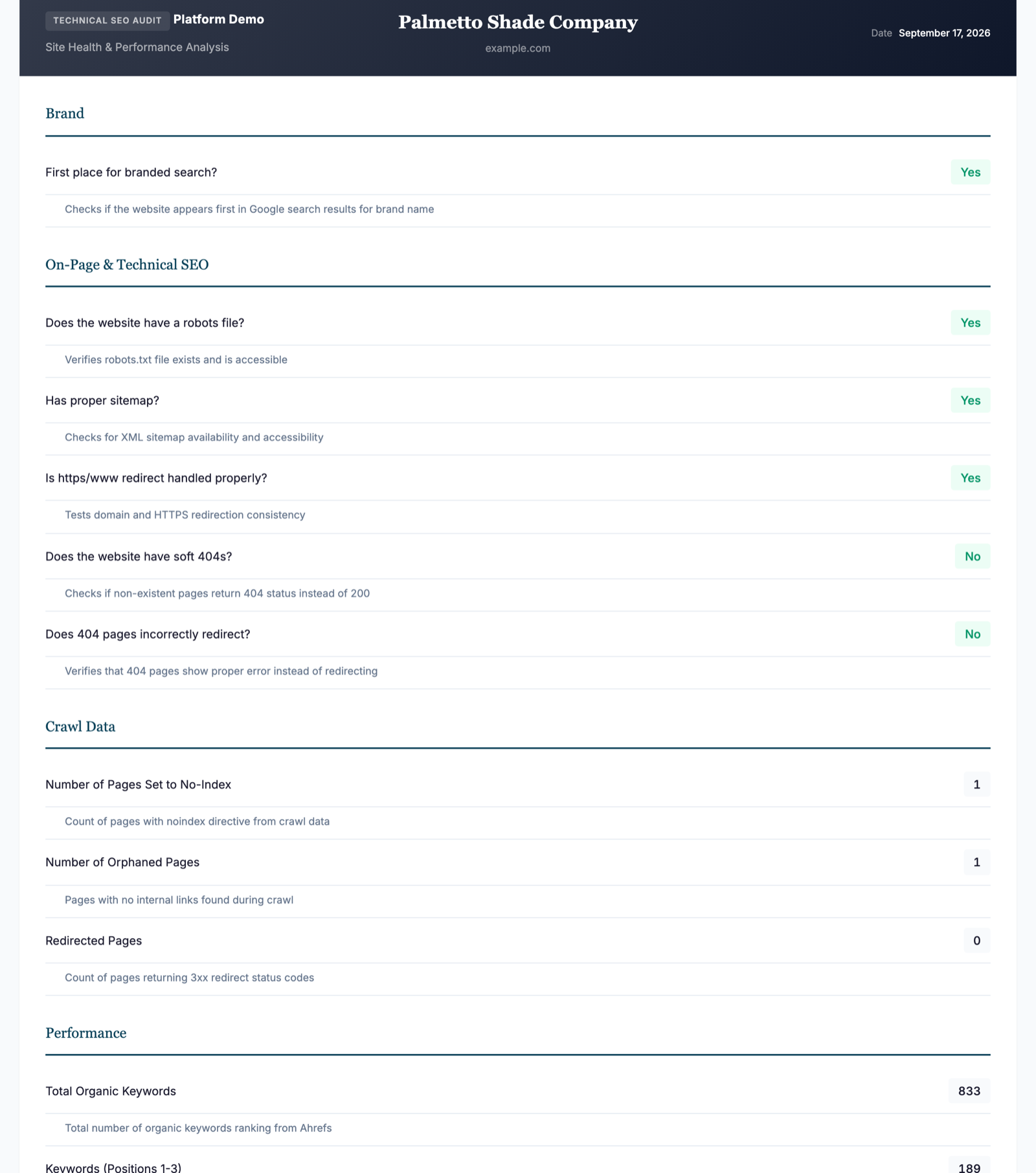
Technical health. Crawl status, robots and sitemap, redirect handling, soft 404s, indexation counts, orphaned pages, page speed and Core Web Vitals, schema, HTTPS. Presented as questions with a yes or no, because that’s how a business owner reads them.
Performance baseline. Organic keywords, keywords in the top three, pages in search results, pages receiving traffic, and the same for each competitor side by side.
Content and on-page. Metadata quality, content volume against the competitors, the mix of content types (service, service area, informational), and whether there’s a blog at all.
Link profile. Domain rating, referring domains, dofollow domains, total backlinks, and the anchor text picture where there’s enough link data to judge it.
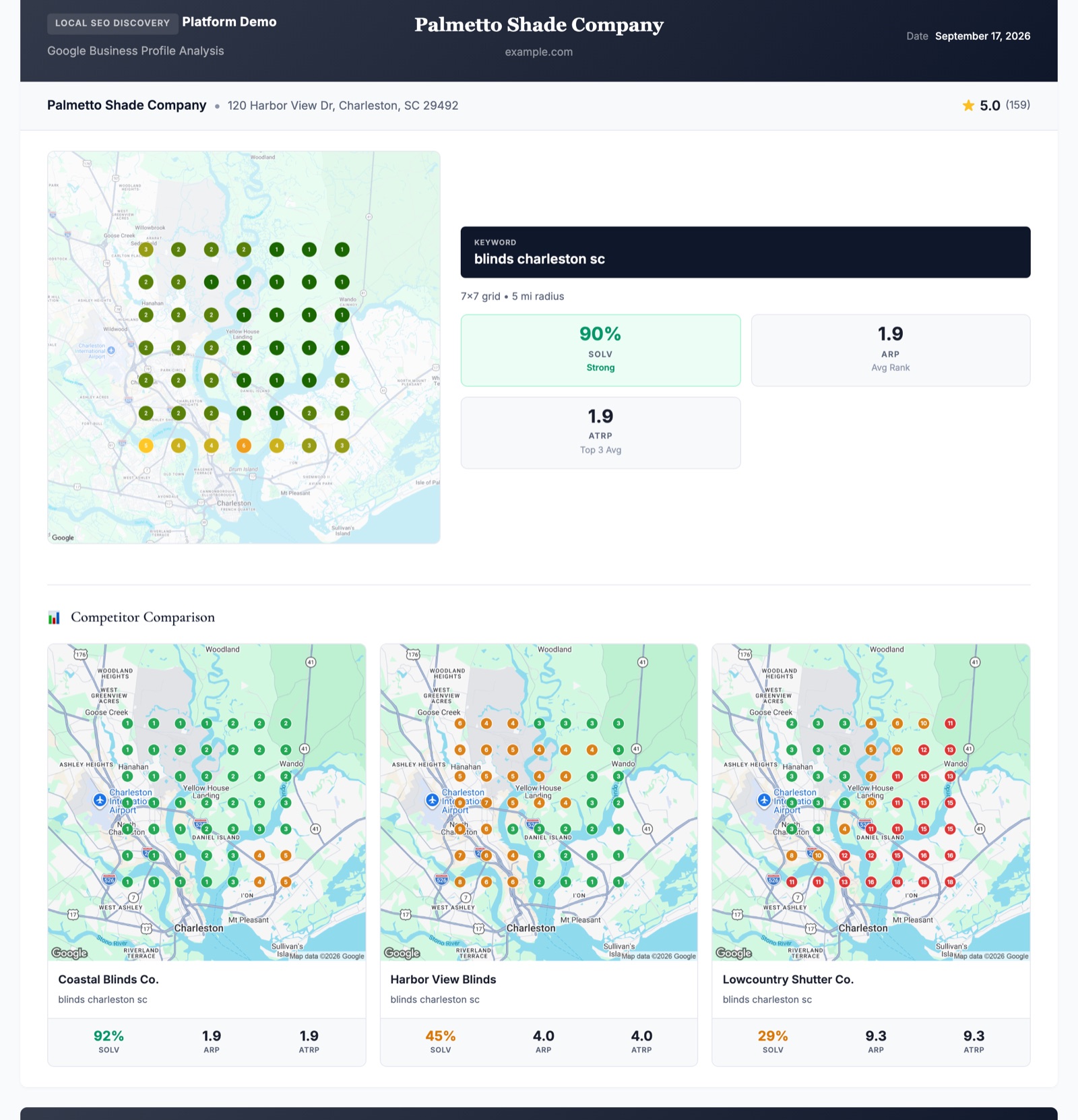
Local SEO. For any business with a location: the Business Profile, reviews, and a ranking grid that shows where the business appears in the map results across its service area, with the same grid for each competitor.
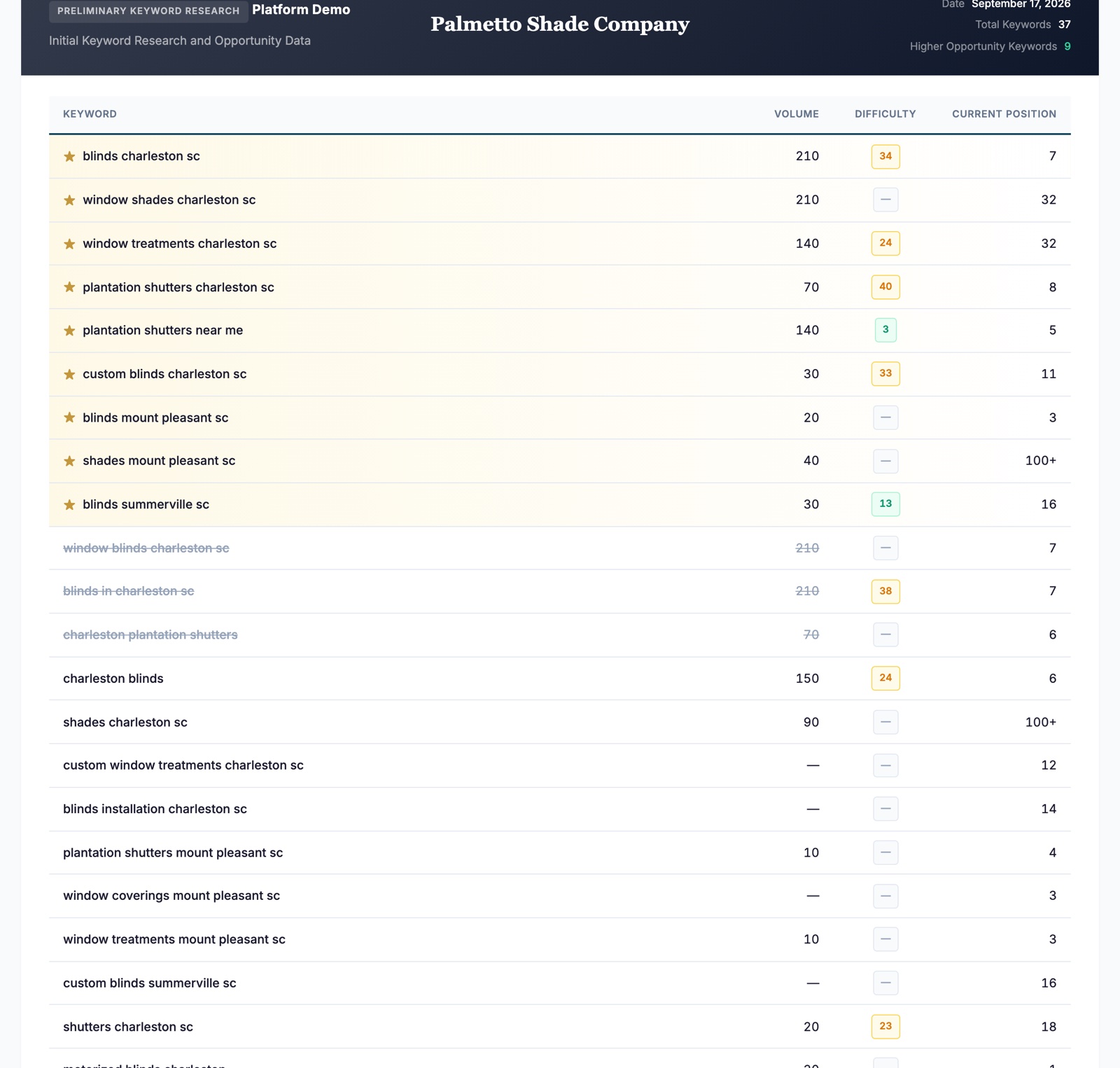
Keyword opportunity. Fifteen to thirty keywords with monthly volume, difficulty, and the prospect’s current position, with the priority terms starred and a plain-language line on why each one matters. Duplicate-volume variants are struck through so the totals aren’t inflated.
Audit software versus an audit
An audit tool finds issues. An audit decides what to do about them. That’s the whole distinction, and it’s the one to keep in mind when a vendor shows you a crawler with your logo on it.
SEO audit software (SEOptimer, AgencyAnalytics, MySiteAuditor, and the like) produces an automated report with the agency’s branding in seconds, at very low cost. The report is a list of everything the rules flagged, weighted by the tool’s idea of severity.
A human-run audit uses the same kind of crawl and data pulls as inputs, then has someone read the site against its market and decide what matters. Two pages with duplicate titles might mean an old page that should be redirected, not two titles to rewrite. A “thin” privacy policy is not a problem. A tool can’t make those calls; a person can.
The trade-off is real and depends on the agency’s positioning.
Software audits work when:
- The audit is purely a lead magnet and volume of submissions matters more than the depth of any one audit
- The end client is a small business that wouldn’t read a longer document anyway
- The agency wants to offer audits at scale across a prospect list
Human audits work when:
- The audit is part of a real sales process for a higher-value engagement
- The end client is sophisticated enough to want analysis rather than a checklist
- The agency wants to differentiate on the quality of its strategic thinking
- The audit feeds directly into paid implementation
We run human audits because that’s where the value is. Software audits are a different product. They’re wrong when the use case needs judgement and fine when it needs volume.
Branding and customization
White-label deliverables go out under the agency’s brand. The standard set:
The branded audit page. Logo, colours, and the agency’s name on every section, hosted so the client never sees the provider. This is the presentation surface for free audits.
PDF deliverable. Branded with the agency’s logo, colours, fonts, and contact details, designed to sit alongside the agency’s other client-facing material.
Slide deck. The same branding for the presentation version, with speaker notes in the agency’s voice.
Spreadsheet companion. The implementation tracker that ships with a paid or campaign-start audit.
Walkthrough recording. Recorded by us for the agency to forward, or by the agency using our material. Either works.
For agencies that want to be on every client call themselves, we also run silent partner mode: we deliver the audit content and the agency handles every client interaction.
The proposal is part of the audit
A free audit that doesn’t end in a next step is a free consultation. The last section of the audit should be the proposal, and it should be short.
At most three options. Each one shows how the campaign runs (planning, strategist review, execution, performance review, monitoring, and how often each happens) and what ships every month (content, links, Business Profile posts). Under that, in plain language written to the prospect: what the option goes after, what shapes the campaign, and what to expect and roughly when. The agency sets the price the client sees. The provider’s price never appears on the page.
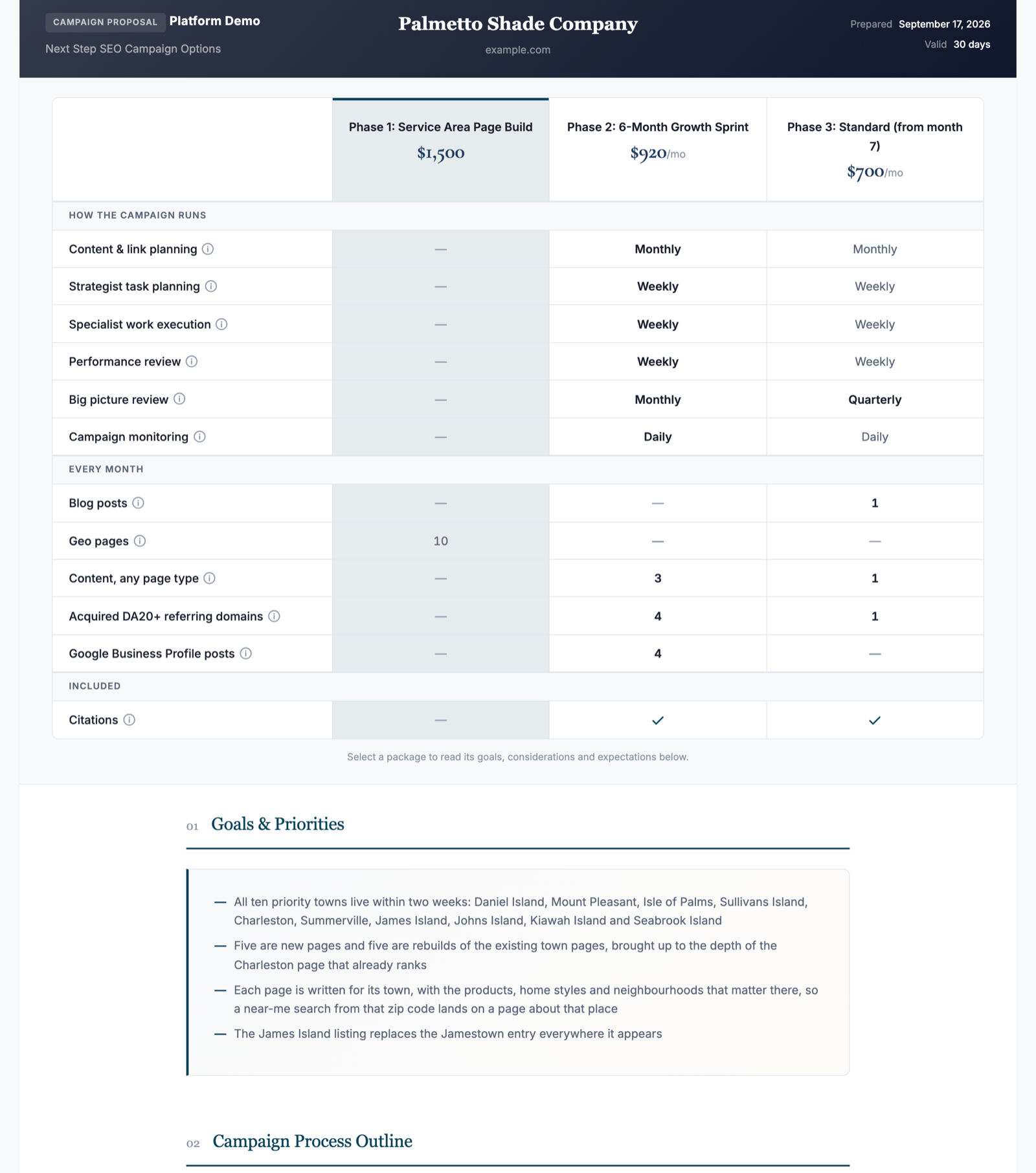
The considerations section is the honest part, and the part agencies are tempted to cut. A note that mobile speed sits with the franchisor’s template, or that the map pack won’t move for towns far from the office, protects the agency six months later. The expectations section does the same job for timelines.
After the sale: the audit that never stops
The campaign-start audit is the last one-off audit the client gets. From there the site is crawled monthly, scored, and every open issue is a decision.
The score matters less than the discipline behind it. Each crawl produces a ranking of issues by severity. Each issue on a page is decided, and the decision is one of four: fix it, redirect the page, remove the page, or dismiss the finding because the check is right in general and wrong for this site. The dismissals are recorded with a reason where anyone at the agency can see and reverse them. A finding the live page contradicts is the crawler being wrong, and that gets reported rather than turned into a task.
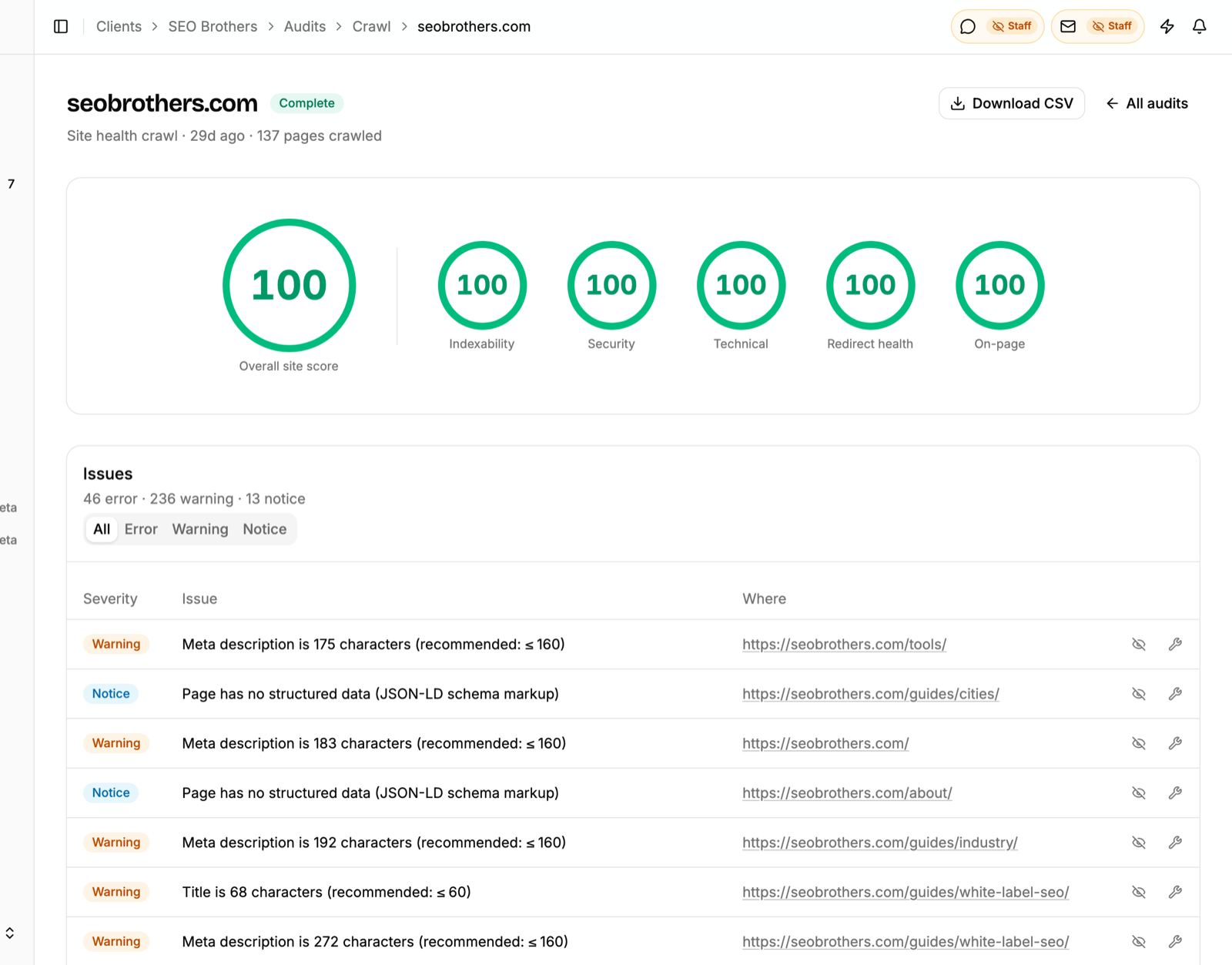
The reason this matters to an agency is defensive. Other agencies will send your client unsolicited tool-based audits arguing your work is poor. A client who sees a monthly crawl with a score, a history, and a note on every open item has an answer for that. A client who last saw an audit at kickoff doesn’t.
How the partnership works
The typical white-label SEO partnership flow:
- Discovery. Agency engages us, we agree on scope and terms.
- Onboarding. Branding assets, deliverable templates, communication preferences, billing setup.
- Audit request. Agency sends the request above. We run the audit.
- Delivery. The branded deliverable goes back to the agency, who presents it to the client. Optional walkthrough call.
- Conversion. If the client engages, the agency sells, we deliver, and the agency keeps the relationship.
For the broader partnership beyond audits, see the white-label SEO reporting guide.
Questions to ask before you resell someone’s audits
The audit is the first thing a prospect sees under your brand. Ask the provider these before you put your name on one.
- Is it scored against the competitors I name, or against a generic checklist? The first sells; the second is a tool export.
- Where is it hosted and what does the client see? If the URL or the footer gives the provider away, it isn’t white-label.
- Who reads it before it goes to my prospect? “Nobody, it’s automated” is an honest answer and a reason to price it as a lead magnet.
- Does it end in a proposal, and do I control the prices on it?
- What does the audit look like in month six? If the answer is “you can order another one”, the campaign has no ongoing audit.
Common questions about white-label SEO audits
How much does a white-label SEO audit cost?
Free audits for prospecting are usually included in the partnership, sometimes with a monthly cap. Paid discovery audits typically run a few thousand dollars, scaling with site size, and most agencies mark them up or bundle them into an implementation project.
How long does a white-label audit take?
Two to three business days for a free audit, one to two weeks for a paid discovery audit. Campaign-start audits run through the first week or two of onboarding, because the keyword mapping needs ranking data to work from.
Will the client know a partner did the audit?
Not from the deliverable. The page, the PDF, and the deck carry the agency’s branding, and the provider never contacts the client. What the agency tells the client about its team is the agency’s call.
Can I edit the audit before it goes out?
Yes, and you should. The keyword table, the summary, and the proposal options are all editable, and sections can be shown or hidden per prospect. The provider’s draft is a starting point.
What’s the difference between a free audit and a paid one?
Depth and purpose. The free audit exists to show a prospect where they stand and what’s possible, with enough specificity to prove someone looked. The paid audit is the full roadmap, priced as a deliverable in its own right.
How we approach white-label audits at SEO Brothers
We’re an SEO-only agency that operates almost entirely through partner agencies. White-label audits are how most new partners enter the relationship: a free audit on one of their prospects lets us demonstrate the work, and a campaign-start audit kicks off the engagement.
The analysis runs on our own platform, the review is done by our senior team, and the presentation is built around each partner’s brand. The end client never sees us in the deliverable.
If you’re a digital agency thinking about offering SEO without building an in-house team, get in touch and we’ll walk through how the partnership works, starting with a free audit on a prospect of yours.
Get our guides in your inbox
Pick what you want to hear about. No spam, unsubscribe anytime.
Check your inbox to confirm your subscription.