AI Agents for SEO Automation: What They Do and Where They Fail

A field report from running AI agents for SEO automation across 360 campaigns. What they do alone, what a person checks, what they are bad at, and a step-by-step guide to building or buying your own.
A field report from more than 360 campaigns. Numbers pulled from our own database on September 25, 2026. We build an agent platform, so read the tools section with that in mind; we say so again when we get there.
Most writing about AI agents for SEO is written by people who have not run one on a paying client’s website. It reads like a product tour: the agent audits, the agent writes, the agent publishes, the agent reports, you sip coffee. We have been running agents on real campaigns since the end of July, and the honest version is stranger and more useful than that.
Here is the short form. Agents are very good at the parts of SEO that are reading and reasoning over data: rankings, crawls, Search Console, the results page, a competitor’s page, your own notes from last month. They are bad at knowing what they do not know about a business, at restraint, and at telling the difference between a fact and a plausible sentence. So the work of running them is deciding what one agent is allowed to see, what it is allowed to touch, and where a person stands between the two.
This guide is that decision, written down, with our numbers attached. If you came here to figure out how much of your SEO automation you can hand to an agent, the short answer is below and the long answer is the rest of the page.
The short answer:
- Where agents are strong: reading and reasoning over rankings, crawls, Search Console and the results page, then turning that into specific, ready-to-approve work.
- Where they fall down: business facts nobody gave them, restraint, and telling a fact from a plausible sentence. The full list is here.
- Our approval line: an agent may decide, write and ask on its own. A person approves anything that touches the client’s website, Business Profile or money.
- What it changed for us: delivery, execution and development run easily ten times faster than before.
- How it is holding: partners send back 9% of agent-written site edits and 45% of agent-written blog drafts.
- Which tool to use: our honest comparison of the best AI agents for SEO, including our own.
- Agent sessions completed
- 5,733
- Campaigns the agents work on
- 363
- Tasks filed by agents
- 6,715
- Agent site edits sent back by partners
- 9%
What is an AI SEO agent?
An AI SEO agent, in the sense we use it, is a program that wakes up on a trigger, reads live data about one campaign, decides what should happen next, and does it through tools, with a large language model doing the reasoning in the middle. The trigger might be a schedule (the second Tuesday of the month), an event (a crawl finished, a partner sent a task back with feedback) or a pickup (an approved task is due).
That is different from two things it gets confused with:
- A chatbot with SEO knowledge. ChatGPT can explain canonical tags. It cannot see that your client’s main location page dropped from position 6 to 14 last Thursday, or that the page ranking for that term is your homepage, not the service page you mapped.
- An automation. A Zapier flow that posts the weekly rank report to Slack is deterministic. An agent is not: the same wake-up context can produce a different plan, which is the whole point and the whole risk.
The useful mental model is an SEO with a senior’s reading speed and range and a new hire’s knowledge of the client: fast, tireless, well read, no memory of last month unless you give it one, and it will confidently invent a phone number if you let it.
What our agents actually do, by the numbers
From the first production session on July 29, 2026, through September 25, 2026:
| Metric | Count |
|---|---|
| Agent sessions completed | 5,733 |
| Sessions that failed (API errors, timeouts) | 337, about 5.5% |
| Campaigns with at least one session | 363 (346 of them in September) |
| Tasks filed by agents | 6,715 |
| Agent definitions in the builder | 46, of which 29 are switched on |
| Instruction documents the agents read | 85 |
| Tools the agents can call | 108 |
A page optimization session reads a few million tokens of context (the rankings, the results page, the competing pages, the Search Console queries) and runs for six or seven minutes. A person doing the same read would take the afternoon.
On cost: the model is the smallest line in a campaign. The larger lines are the people who review and implement the work, the rank tracking, crawl and link data the agents read, and the platform they run on. When a vendor prices an agent off token cost alone, ask who reads the output before it reaches your client.
The word “agent” hides a lot of variety, so here is what those 29 switched-on agents are for, grouped by job.
| Agent type | Wakes when | What it does |
|---|---|---|
| Planning (6) | Monthly, per campaign | Decides the next month’s work in one lane |
| Specialist | A task reaches it | Writes the brief, the draft or the article, reviews it, publishes it |
| Feedback | A person sends work back | Revises the task, plan or draft in place |
| Internal | Something needs plumbing | Onboarding, alert triage, knowledge checks, call summaries |
Planning agents (six of them, and the only ones a partner sees run) each own one slice of a campaign and wake monthly:
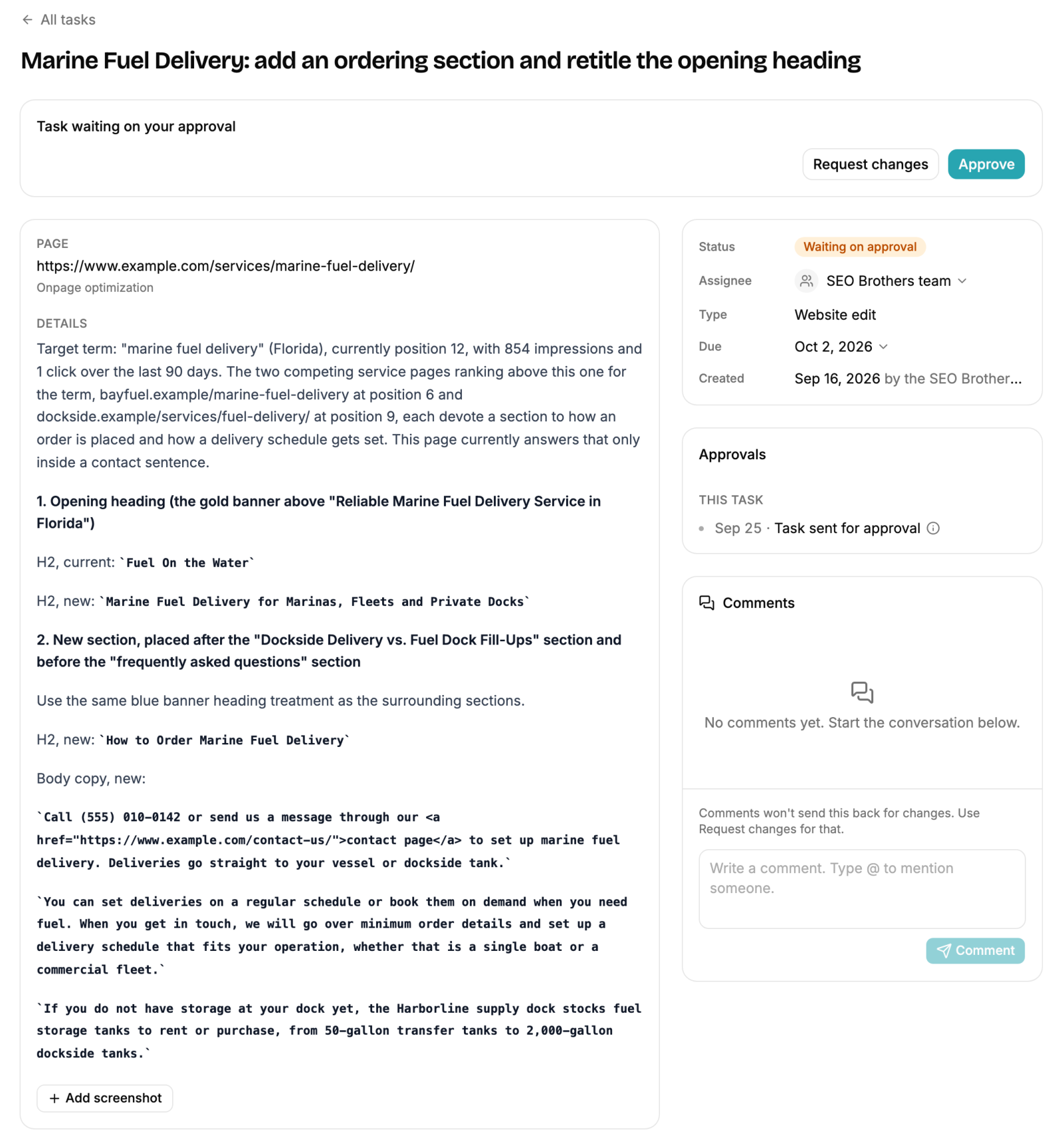
- Page-specific optimization: picks two search intents, finds the page that owns each, compares it against the pages that actually rank for that term from the client’s location, and files one task per page with the exact current and new title, meta description and copy.
- Site-wide optimization: the same idea for things that repeat across pages, like a template title pattern or a footer.
- Crawl score maintenance: wakes only while the latest crawl has open issues, and ends the session with every issue turned into a fix task, a redirect, a removal, an ignore rule for a crawler misread, or a question.
- Blog content planning, link building planning, Business Profile post planning: each checks how much runway the campaign has against what the partner bought, and drafts the next month’s plan when coverage runs short.
The specialists are where a deliverable gets made: brief writers for blog posts and location pages, content writers for each, a QA reviewer, guest post topic and article writers, and publishers that push an approved post to the site. Feedback agents revise inside the same task, so the approval thread stays whole.
What they have filed, by kind, is a fair picture of where the work goes:
Just over a thousand of those are done. Of the 212 completed on-page site edits, 206 were implemented by our fulfillment team, by hand or through the site connector, and 3 by the partner’s own people. The posts, articles and links went out through the publishing pipeline once approved. All of it lands in the monthly client report as work delivered, which is the part of white-label SEO reporting clients check first.
One number we watch more than any of those: 1,481 notebooks across 314 campaigns. Every agent keeps a private working note per campaign, what it is in the middle of, what it decided not to do and why, what it is watching. It is the closest thing to memory the system has, and we will come back to why it is private.
Where we draw the approval line
The line is simple to state and took two months to get right: an agent may decide, write and ask on its own. A person approves anything that touches the client’s website, the client’s Business Profile, or the client’s money.
- Read everything: rankings, Search Console, the crawl, the results page, competitor pages, the campaign's goal, rules and facts, its own notebook
- Decide the next best move and file it as a task with a one-sentence defense
- Write the draft: the new title, the new section, the schema block, the redirect rules, the post
- Revise or withdraw its own future tasks when the data stops supporting them
- Ask the partner a question when the answer changes what it would do
- Escalate to us when a tool is broken or data is missing
- Every site edit, before it lands, approved as the exact strings
- Every plan (content, links, posts) before any of its pieces start
- Every blog post and location page draft
- Every fact about the business
That one rule did more for quality than any prompt about being careful. The partner approves the exact strings. If any writing or choosing would still happen after the approval, the task is not ready and the agent is not allowed to file it.
Facts work the same way. Agents read facts; only people write them. If an agent verifies that a stated fact is wrong, it records its own beside it and opens an ask. It never edits what a person said. And escalations come to us, never to the partner: the partner cannot fix our crawler, and should not be told about it in a task.
How that line is holding, from the approval records as of September 25, 2026:
Read the first three bars together and you have the state of the art in one chart. Site edits, where the agent works from data it can see (the live page, the results page, the tracker), get approved nine times in ten. Blog posts, where the agent works from what it believes about a business, get sent back almost half the time. The feedback is instructive, and it falls into a few buckets. Leave the phone numbers alone, because many businesses run different tracking numbers for different purposes. Add internal links, because the draft has none. Match the client’s voice and style guide. Do not promise timelines the business has not promised.
None of those are things the model could not do. They are things it did not know, or was not told firmly enough. Which brings us to the section people actually came here for.
What AI agents are bad at
We keep a running list. These are the ones that cost us real partner trust or real money to learn. The short version first, then each one in detail.
| What goes wrong | What we did about it |
|---|---|
| 1. Fills gaps in business facts with plausible sentences | No source on the site or in the brief, the claim is cut |
| 2. Creates work for the sake of it | Monthly caps and page holds, enforced in code |
| 3. Applies generic best practice | Classify what ranks by page type first |
| 4. Narrates a page’s history | State the change and leave out the backstory |
| 5. Hedges and hands off judgment | Run the check in the session, or do not file |
| 6. Trusts old notes over live data | Live campaign data wins, rebuilt every session |
| 7. Believes crawler false positives | Decide the page’s job before its issues |
| 8. Leaks tool and provider names | Banned in partner copy; problems escalate to us |
| 9. Rushes when told about time limits | Limits enforced silently by the runtime |
| 10. Picks a side in a contradiction | Asks the business instead |
1. They do not know what they do not know about the business. The model has read the internet. It has not read the client’s tracking-number setup, the fact that the business dropped one of its services last spring, or that the owner no longer wants the site to claim a particular certification. Left alone, an agent fills those gaps with the most plausible sentence. Our fix is a hard rule: a claim about the business (what it does, prices, timelines, credentials, offers, guarantees) appears in agent copy only when the site or the brief states it and the agent found it this session. No source, the sentence is cut. Never kept with “confirm with client” stapled on.
2. They cannot leave well enough alone. Every planning agent, given a campaign and a tool that creates tasks, wants to create tasks. The single most valuable sentence in our planning instructions is: “A session that verifies the upcoming tasks are still the right ones and creates nothing is a good session.” We also cap it. The instructions allow at most five site edits a month per campaign. The code refuses a second open on-page task on a page, and refuses any on-page task on a page for seven days after the last one completed. The holds live in code rather than the prompt because a prompt is a suggestion and a refusal is a refusal. The same goes for evidence: the tool that files a task refuses any client URL the agent did not fetch live in that session.
3. They reach for best practice when they should be reading the results page. Told to improve a service page, an agent’s instinct is the generic checklist: longer, more headings, FAQ block. The right move comes from classifying what actually ranks for the term, by page type, which is searcher intent read straight off the results page. If homepages rank for “home cleaning Halifax,” a dedicated service page titled that way is a bet against the SERP. Our instruction now says to classify by page type before touching a title, and to mirror the winning type, never the title pattern of a page that ranks by accident. Agents get this right when told; they almost never do it unprompted.
4. They narrate history, and it embarrasses people. “This was staged in April and never implemented.” True, and unforgivable in a task the partner opens with their client in the room. Agents default to explaining how a page got into its state. The rule is: state the change, never the history. Title, current: X. Title, new: Y.
5. They hedge, and a hedge is delegated judgment. “Sanity check whether the page has been updated before changing the title.” That is the agent handing its own homework to the implementer. If the check can be run in the session, the agent runs it and writes the task from the conclusion. If it cannot, the task is not filed.
6. They trust their own notes over the world. An agent’s notebook from last month says the location page exists. The page was deleted two weeks ago. The agent plans around a page that is not there. We had to write it down: when a note and the campaign disagree, the campaign is right and the note is wrong. Wake-up data is rebuilt fresh every session and is never copied into memory.
7. They believe the crawler. A broken-link finding built from a javascript: pseudo-link. A malformed self-referencing blog URL the crawler recorded that does not exist on the site. A page flagged as orphaned that sits in the footer. Tracking beacons counted as images. An agent takes each finding as fact and files a task. The fix was partly on the tool side and partly a session rule: a page is decided before its issues are. A page with no job gets redirected or retired, not fixed issue by issue.
8. They leak the machinery. Tool names, data provider names, task ids, “the crawl failed,” “my session does not have a tool to start a crawl.” All of it shows up in partner-facing copy unless forbidden. We forbid it: nothing an agent writes names a tool, a provider, an id or a status of the platform. Tool problems go to an escalation, which only we see. 120 escalations in 5,733 sessions, about 2%, and the commonest are “no audited crawl exists for this campaign” and “Search Console is not connected.” Both are our problems, correctly routed to us.
9. They are bad at time. Give an agent a time limit in its instructions and it starts rushing and reporting on its own clock (“I have limited time, so I will skip”). We took every mention of time out of the prompts. Limits are enforced by the runtime, silently. The agent’s job is the work; the clock is ours.
10. They cannot settle a contradiction. The site says the consultation costs $99 on one page and is free on another. The agent picks one and writes it as the practice’s word. Now the reader has been told a price by software. Our rule: the site cannot settle which is current, the business can, and an ask is how the question reaches them. Do not fill the gap with an invented answer while waiting.
None of this is a case against agents. Every item on the list is now a line in an instruction document or a constraint in code, and the sent-back rate on site edits is 9%. But if you are asking “should I let an agent run my SEO unsupervised,” the list is the answer.
Three arguments we kept having
Building this was mostly arguing. Three of the arguments came up often enough to be worth passing on.
One general agent, or many narrow ones?
We started with one. A daily agent that read the entire campaign, every data feed, every open task, and decided what to do. It ran 128 sessions between August 3 and August 26, and then we switched it off.
The problem was not intelligence. It was that a session with everything in front of it does a little of everything and nothing well, and when it went wrong nobody could say which of dozens of inputs sent it sideways. We could not test “what if it saw less data” without a deploy, because the recipe was in code.
The replacement is the builder we run now, where an agent is a row of settings in a table. Trigger, schedule, which data sets ride into its first message, which documents compose its instructions, which tools it may call, which campaigns it is scoped to, whether a partner can see it. The page optimization agent reads rankings, Search Console, the crawl and the keyword map, and sees two search intents. The crawl maintenance agent sees the open issues and nothing about content plans. Each does one thing, and when one misbehaves, the fix lands on one row.
The cost is coordination. Two agents can file tasks against the same page, so there is a rule that a page with an open task in any lane is taken, and the second agent picks another. There is a shared “session discipline” document that every planning agent reads first, and it wins over anything below it. We are not going back.
Train with specifics, or nudge?
Our first instruction documents were nudges. “Be thorough.” “Consider competitive context.” “Use good judgment about when to create a task.” Reading the transcripts, nudges do nothing measurable. The model already intends to be thorough.
What works is a specific trigger and a specific checkpoint, and then stopping. “Before creating or retargeting any page, classify the SERP by page type.” “Read the page’s Search Console queries before the Why is written.” “Check which of our URLs ranks for a term before moving anything.” Each of those names a moment and a check. None of them names the outcome, because the moment you write “then rewrite the title to include the city,” the agent rewrites every title to include the city, on the pages where it fits and the pages where it does not. Guidance stops at the decision point.
The other thing that works is layering. Every agent reads the campaign’s knowledge in five kinds, and the document tells it how to weigh each: rules bind (a person’s always or never; nothing overrides one, and if it looks wrong, follow it and ask). The goal directs. Guidance leans (a person’s preference the agent may go against with evidence, inside a task that says so). Facts inform (dated, sourced, only written by people). The notebook is the agent’s own and overrides nothing. That ordering resolved most of the “why did it do that” questions before they were asked.
How we test a change to a document: one variable at a time. Change one line, run the agent on the same campaigns, read every task it produced with a person’s eyes, compare. We keep a clean-room copy of each agent that runs outside production so the reps are cheap, and we run an instruction line with and without its change on scenario prompts before it goes near a live campaign. It is slow. It is the only method that has ever told us the truth.
Should agents hand off to people, or finish the job?
The honest answer is that it depends on the surface, and we ended up with three different answers.
For site edits, the agent hands off completely. It writes the task to implementation level (exact strings, the schema block with real values, the redirect rules) and stops. A person approves, then either our fulfillment team or the partner implements it, through the connector on the 143 connected WordPress sites or by hand elsewhere. The agent never touches the live site. Not because it could not; because the approval has to be of the exact thing that will change, and a partner who approved “improve the title” and got a different title than they pictured does not approve the next one.
For content, the agent finishes the draft and hands off for approval, and feedback comes back to the same agent inside the same task. The revision rides the approval thread. Opening a sibling task to apply feedback was one of our worse early ideas: the partner ends up with two tasks and no memory of which one they were reviewing.
For questions, the agent hands off and does not wait. An ask goes to the partner, the session ends, and the answer wakes a fresh session later that reads the agent’s own note about why it asked and what each answer means. Blocking a session on a human reply was the alternative, and it means paying for an agent to sit there.
The pattern underneath all three: the handoff happens at whatever point a wrong guess would put a wrong claim in front of the client. Everything before that point, the agent does. Everything after it, a person does.
How to use AI agents for SEO: a step-by-step
This is the order we would build in if we started again, whether you are building on your own stack or configuring someone else’s. The checklist first, then the detail.
| Step | The question it answers |
|---|---|
| 1. Pick one job and one trigger | What wakes it, and what is it for? |
| 2. Decide what it reads | Which data rides into the session, with what limits? |
| 3. Decide what it can touch | Which tools, and which ones it never gets? |
| 4. Write triggers and checkpoints | Where must it stop and check? |
| 5. Put the approval line in code | What can it never ship without a person? |
| 6. Keep two kinds of memory | What is a fact, and what is its own note? |
| 7. Run reps and read everything | What did it actually do, call by call? |
| 8. Measure what a person would | How often does its work get sent back? |
| 9. Scale by scope | Who gets it next, and who reviews first? |
1. Pick one job and one trigger. Not “run SEO.” One job: keep the crawl clean. Plan next month’s posts. Optimize two pages a month against what outranks them. Name the trigger that wakes it: a schedule, an event, a due task. If you cannot name the trigger, it is not an agent yet, it is a wish.
2. Decide what it reads. List the data that rides into the session, with limits: the last 30 days of rankings, the latest crawl’s open issues, the top 50 Search Console queries for the page, the campaign’s goal and rules, the agent’s own notebook. Less than you think. A session with everything reads like a session with nothing.
3. Decide what it can touch. Give it the tools for its job and no others. A planning agent gets tools to read the results page, fetch a live URL, check a page’s rankings, file a task, update its notebook, ask the partner a question and escalate to us. It does not get a publish tool. The tool list is the real permission system; the prompt is not.
4. Write the instructions as triggers and checkpoints. Not outcomes. “Before X, check Y.” “A task is filed only when Z is true.” Put the rules that must hold whatever it finds at the top, and say they win. Write in the words the reader of the output will read, because the agent will echo your vocabulary: if your instructions say “partner” and “platform,” so will its tasks.
5. Put the approval line in code. Decide which outputs a person must approve, and enforce it in the system, not the prompt. An agent-filed site edit is born waiting for approval. A hold on a page after an edit is a refusal the task tool enforces, not a sentence the agent may weigh.
6. Give it memory in two kinds and keep them apart. Facts about the business, written by people, read by every agent. A private notebook per agent per campaign for its own working state, which nobody else reads and which never counts as evidence that something exists. The moment those two blur, agents start planning around things that are not there.
7. Run reps and read everything. Run it on three real campaigns. Read the transcript, every tool call in order, every task, the notebook. Grep for “not available,” “worked around,” “I do not have a tool.” Agents flag their blockers in prose far more often than they escalate. Fix one thing. Run again. Do not touch a second thing until the first is proven.
8. Measure what a person would measure. Sent-back rate by output kind. Escalations per hundred sessions. Cost per session. Tasks withdrawn by the agent itself (a sign it is revising, which is good) versus tasks cancelled by a person (a sign it is filing junk). Sessions that created nothing, which should be common.
9. Scale by scope, not by ambition. Turn it on for one partner. Then a profile of campaigns (local service businesses). Then everyone. Keep a probation mode where new agents’ tasks are held for your own review before a partner ever sees one.
Build or buy
Build if SEO delivery is your product and you need the recipe to be yours: your rules, your approval line, your data. The cost is real. The model spend is the small part. The large part is the surface around it: the tools that read your rank tracker, crawler and Search Console, the task and approval system the agent files into, the connector that implements on the site, the transcript store you will live in for the first month, and the person who reads transcripts. It took a small team a summer to get to a 9% sent-back rate on site edits.
Buy if you run campaigns and want the outputs, not the recipe. Then the question to ask a vendor is the approval line question: what does the agent do alone, what does a person check, and can I see the full reasoning behind each task? If the answer to the last one is a summary, keep looking.
Configure (the middle path) if you have an ops person and a workflow tool. n8n or AirOps plus a model plus your data sources will get you a planning agent in a week. The thing you will not get for free is the discipline layer, and it is the layer that decides whether your partners trust the output.
The best AI agents for SEO, honestly
Disclosure first: we build Tideworthy, one of the tools below. We have tried to describe every tool by what it executes versus what it recommends, from its own materials and independent reviews, and to be as blunt about ours as about theirs. Prices are the vendors’ published figures as of September 25, 2026 and change often.
| Tool | What it mainly does | Changes the live site? | Price |
|---|---|---|---|
| Search Atlas OTTO | Deploys on-page fixes through a pixel | Yes, mostly with approval | $79 to $319/mo |
| Alli AI | Bulk on-page edits at scale | Yes | $249 to $499/mo |
| Ahrefs Letaido | Turns Ahrefs data into tasks and reports | Routes output to other tools | $99/mo |
| Semrush Copilot | Recommendations inside Semrush | No | Included |
| Surfer | Content optimization against what ranks | No | Paid plans |
| AirOps | Content workflow builder | Through your workflows | Free solo tier |
| Frase | Content research through publishing | Can publish at set autonomy | $49 to $299/mo |
| Nightwatch NightOwl | Monitoring and recommendations | Early | €79 to €399/mo |
| SEObot | Bulk article writing and publishing | Publishes articles | From $49/mo |
| n8n or your own stack | Whatever you build | If you build it | Model cost plus your time |
| Tideworthy (ours) | Per-campaign agents filing approval-ready tasks | Only after approval | See pricing |
The detail on each:
Search Atlas OTTO. The most autonomous of the group: it deploys changes (meta tags, schema, internal links, content fixes) to the live site through a JavaScript snippet, which sidesteps the CMS entirely. Reviews consistently note that most updates still need your approval, and that pricing ($79 to $319 a month, with agency plans from $999) adds up across many sites. If you want a single site fixed with minimal setup, it is the reference point. If you are an agency that needs to explain to a client what changed and why, the snippet model gives you less to show than a task record does.
Alli AI. Same idea as OTTO, agency tier: scans, then edits titles, descriptions, schema and internal links on the live site. $249 to $499 a month on the published plans, with enterprise priced on request. Built for people who already know what they want changed and want it applied at scale.
Ahrefs Letaido (formerly Agent A). An agent that turns Ahrefs data into work: content gap analysis, cannibalization checks, technical audits, reports, and it can push outputs into Notion, HubSpot, Slack or WordPress. $99 a month, usable on its own, and it connects to your Ahrefs data if you already subscribe. Strong if you live in Ahrefs; it recommends and routes more than it executes.
Semrush Copilot. An assistant inside the Semrush dashboard that surfaces prioritized recommendations across Site Audit, Position Tracking and Backlinks. It is included in every plan and it does not act on anything. Semrush’s recent investment has gone into AI visibility measurement more than execution.
Surfer. Content optimization against the pages that currently rank: structure, entities, term coverage, a score. The best of the group at on-page depth, and it stays focused on content: it has added AI visibility tracking and ranking alerts, but no orchestration and no technical fixes.
AirOps. A workflow builder: drag-and-drop steps from research to writing to schema to publish, with approval steps, and bulk operations across hundreds of articles. Free solo tier, custom pricing above. It is the “configure” path from the previous section, and the honest limitation from its own reviewers is that you will spend real time shaping workflows to your process.
Frase. Conversational agent covering the content pipeline from research to publishing and visibility tracking. Its own material says users still set strategy and approve output. Content-first; not a technical or planning agent.
NightOwl (Nightwatch). An always-on layer on top of a rank tracker: monitoring, audits, ranked recommendations. €79 to €399 a month on its published plans, plus metered agent credits. Best for teams already living in rank tracking; the autonomous action side is early.
SEObot and similar. Bulk keyword research, article writing and publishing, from $49 a month. Fine for volume on sites nobody’s reputation depends on. The reviewers’ own caveat is the one we would give: without a person reviewing, it reads like a robot wrote it, because one did.
n8n, or your own stack with Claude or ChatGPT. A general model is not an SEO agent until you connect it to your data and your tools. Do that and you have the most flexible option on the list, and the most maintenance. This is what we did, on our own stack, and everything above this line is what it cost.
Tideworthy (ours). A white-label platform for agencies: the agents described in this guide, running per campaign on your clients, under your brand, filing tasks into an approval queue you and your client can see, with every session’s reasoning attached. It does not deploy anything to a live site without an approval, and it is opinionated about the handoff line in the ways this guide describes. It is not the right tool if you want a snippet that fixes one site tonight, and it is not a keyword research tool; it plugs into those. Pricing is on the Tideworthy page.
If we had to reduce the whole list to one question: does it show you why? An agent that makes a change and shows you a diff is a tool. An agent that files a task with the results page it read, the competitor it compared against and the Search Console query it built the decision on is a colleague you can check. Buy the second kind.
AI agents for content creation
Content is where most people meet an SEO agent first, and where the numbers are least flattering, so it deserves its own section.
Our content pipeline is four agents in a row, with a person at the two points that matter: the plan and the draft.
- Agent Monthly content plan Topics from search intent gaps and competitor coverage388
- Person Partner approves the plan 22% of plans come back with changes
- Agent Brief Target term, page type, sections, internal links, allowed facts1,208
- Agent Draft Written from the brief111
- Agent QA review Checks the draft against the brief29
- Person Partner approves the draft Feedback rides the same task; the agent revises in place
Guest posts run on their own track: 611 topic sessions and 625 article sessions in the same 30 days.
The shape is the lesson. Briefs outnumber drafts ten to one, because the brief is where a post is decided: the target term, the page type the SERP rewards, the sections, the internal links, the facts from the site it may use, the facts it may not invent. A draft written from a good brief gets approved. A draft written from a headline gets sent back. Our blog drafts still come back 45% of the time, and almost every send-back is something the brief should have carried.
What agents are good at in content: reading the ten pages that rank and describing the shape the SERP rewards. Building an outline that covers what the reader came for. Writing a first draft in ten minutes at a quality a junior writer would take a day to reach. Producing a month of Business Profile posts for a campaign without repeating itself, from verified business details. Revising against feedback, precisely, when the feedback is precise.
What they are bad at: voice, unless the brief carries the voice guide and the draft is checked against it. Internal links, unless the brief lists them. Restraint about claims: the model writes “we offer 24-hour emergency service” because most plumbers do. Knowing when a topic is too thin for a post and should be a section on an existing page instead (our planning agent is told to read weak pages as intent signals, and sometimes it does).
The workflow that survives contact with partners:
- Plan monthly, in a batch the partner approves once. Topics come from search intent gaps and competitor coverage, never from a keyword volume list alone.
- Brief every post before a word of body copy exists. The brief carries the voice guide, the internal links and the facts. It is the artifact worth a person’s time.
- Draft from the brief. Run a QA pass that checks the draft against the brief, not against a generic rubric.
- A person approves the draft. Feedback rides the same task; the agent revises in place. “Approved with pending feedback” exists for the cases where the post is fine and the note is about next time.
- Publish through the connector, with the SEO fields set, and only then.
If you take one thing from the section: buy or build a briefing agent first, and let the drafting be the boring part.
Where this goes
Two months in, the change is bigger than we expected. Our speed of delivery, execution and development is easily ten times what it was before the agents. The work has also moved up a level: the people who used to write title tags now read agent-filed tasks and decide, and the people who used to chase a monthly plan now approve one. The campaigns get more attention than a human team could give 360 of them, and the sent-back rates tell us whether the attention is any good.
The thing we would tell an agency starting this week is the thing we would tell ourselves in July.
Decide what the agent may do alone, what a person must see, and where a wrong guess would hurt a client, and build the system around that line. Everything else is iteration, and the iteration is mostly reading.
If you are working out where agents fit next to AI search more broadly, our AI SEO guide covers the citation side, and white-label AI SEO is how we deliver it for agencies. If you want to see the agents in this guide run on one of your own campaigns, start a free Tideworthy account. No card, and nothing ships to a client’s site without your approval.
Numbers in this guide come from our production database on September 25, 2026 and will be stale by the time you read them. If you want to see a session’s reasoning end to end, ask us for one.
Get our guides in your inbox
Pick what you want to hear about. No spam, unsubscribe anytime.
Check your inbox to confirm your subscription.